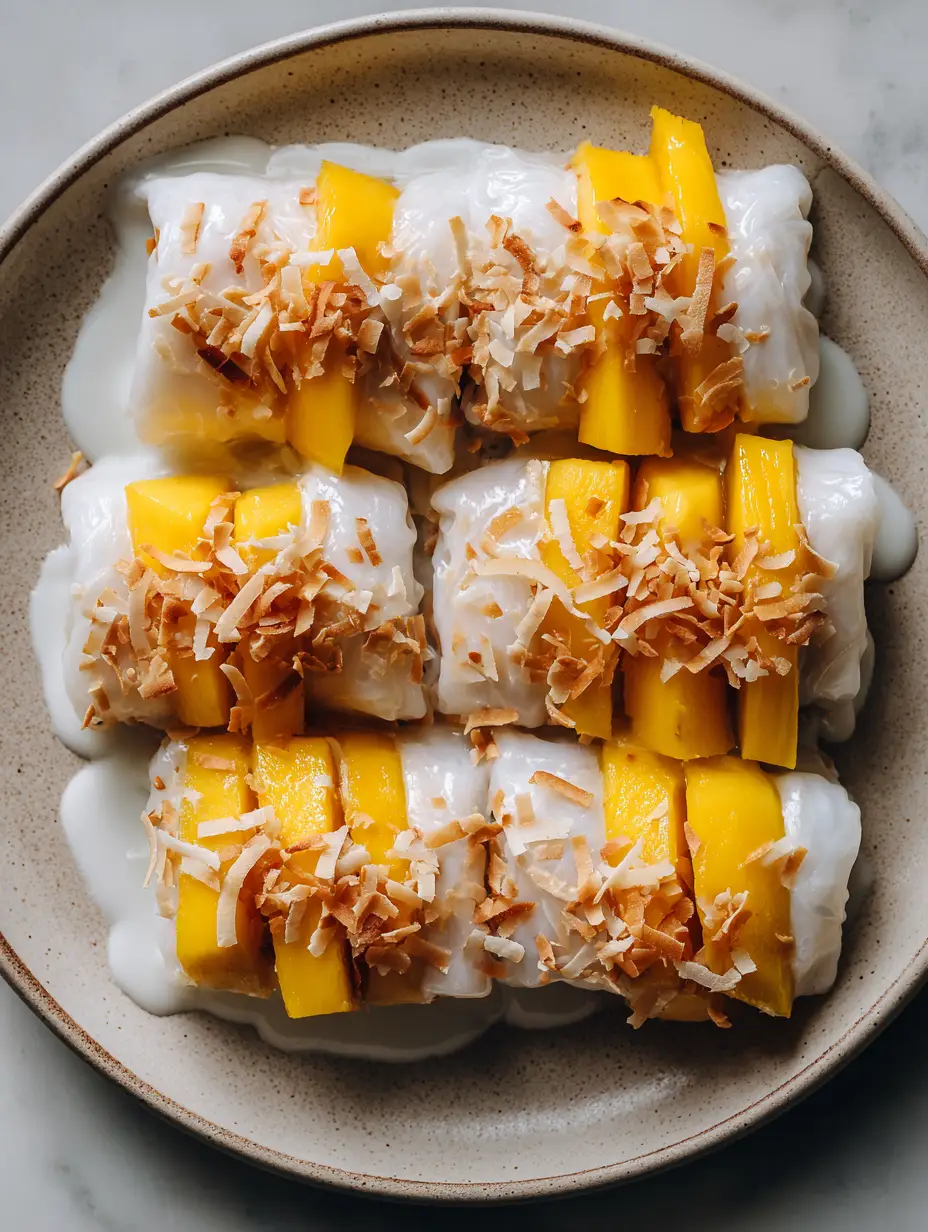
Mango Sticky Rice Rolls are the sophisticated, portable evolution of Thailand’s most beloved street food export. Imagine the classic flavors of Khao Niew Mamuang, but reimagined into a sleek, handheld format that features translucent, glistening white glutinous rice and vibrant yellow fresh mango spears.
This recipe focuses on achieving that perfect forensic visual match: a chewy rice exterior generously coated in golden-brown toasted coconut flakes. Topped with a thick, opaque white coconut milk reduction, these rolls are a masterclass in tropical texture and balanced sweetness.
Whether you are hosting a summer soirée or looking for a creative twist on a traditional favorite, these Mango Sticky Rice Rolls provide a restaurant-quality experience right in your home kitchen. Let’s dive into the science of the perfect steam and the art of the roll.

Why You Will Fall in Love With These Tropical Dessert Rolls
- Handheld Convenience: Unlike the traditional plated version, these rolls are perfect for parties and easy grazing.
- Glistening Textures: The use of long-grain glutinous rice ensures a translucent, pearlescent finish that catches the light beautifully.
- Toasted Nutty Crunch: The golden-brown toasted coconut flakes provide a necessary structural contrast to the soft mango.
- Concentrated Flavor: Our thick coconut cream drizzle is reduced to ensure maximum coconut impact without making the rice soggy.
The Anatomy of a Perfect Mango Sticky Rice Roll
To achieve the results seen in our visual blueprint, we must select the highest quality ingredients. The rice must be “sticky” but each grain should remain distinct and glistening, never mushy or opaque.
Long-Grain Glutinous Rice (Thai Sweet Rice): Do not substitute this with jasmine or arborio rice. You need 2 cups (400g) of true glutinous rice to achieve that signature “translucent” look and chewy bite.
Fresh Ripe Mangoes: Seek out Champagne (Ataulfo) or Nam Dok Mai mangoes for their fiberless, buttery texture and vibrant yellow hue. You will need 2 large mangoes, sliced into uniform 1/2-inch (1.25cm) spears.
Full-Fat Coconut Milk: Use high-quality canned coconut milk for the rice soak and the drizzle. You’ll need one 13.5oz (400ml) can, split between the rice seasoning and the topping reduction.
Unsweetened Shredded Coconut: 1 cup (75g) of shredded coconut will be dry-toasted until it reaches a specific golden-brown color. This provides the outer “crust” of the roll.
Granulated Sugar and Sea Salt: We use 1/2 cup (100g) of sugar to sweeten the coconut milk. A pinch of sea salt is essential to balance the richness of the cream and the sweetness of the fruit.
Cornstarch (Foundational Ingredient): 1 tsp (5g) of cornstarch mixed with a little water is the secret to creating that thick, opaque white drizzle that stays put on top of the roll.
Essential Culinary Tools for Rolling Success
Achieving the uniform shape of these Mango Sticky Rice Rolls requires a few specific kitchen tools. First, a bamboo steamer basket or a fine-mesh steamer insert is non-negotiable for cooking the rice correctly.
A bamboo rolling mat (like those used for sushi) lined with plastic wrap will help you apply even pressure. This ensures the glutinous rice tightly hugs the mango spear without sticking to your hands or the counter.
Finally, a small heavy-bottomed saucepan is required to reduce the coconut cream. This allows for even heat distribution, preventing the sugar in the cream from scorching while it thickens into that iconic opaque drizzle.
Phase 1: Preparing the Glistening Glutinous Rice
The journey to perfect Mango Sticky Rice Rolls begins with the rice. Start by rinsing 2 cups (400g) of glutinous rice in cold water until the water runs clear; this removes excess surface starch that causes clumping.
Soak the rice in plenty of filtered water for at least 4 hours, or ideally overnight. This long soak allows the hard grains to hydrate fully, ensuring they steam into a translucent, tender state rather than remaining chalky in the center.
Drain the rice and spread it evenly in a cheesecloth-lined steamer basket. Steam over boiling water for 20-25 minutes. You will know it is ready when the grains appear translucent and feel tender but still possess a distinct “bounce” when bitten.
Phase 2: Seasoning and Setting the Rice
While the rice steams, prepare the coconut seasoning. In a small pot, combine 1 cup (240ml) of coconut milk, 1/2 cup (100g) of sugar, and 1/2 tsp (3g) of salt over medium heat until the sugar dissolves.
Transfer the hot, freshly steamed rice into a ceramic bowl and immediately pour 3/4 of the warm coconut mixture over it. Stir gently with a wooden spoon, then cover the bowl with a clean towel for 20 minutes.
This “resting phase” is critical. The rice absorbs the sweetened coconut milk, transforming from matte to a glistening, pearlescent finish that is the hallmark of professional Mango Sticky Rice Rolls.

Phase 3: Crafting the Golden Toasted Coconut and Mango Spears
While the rice rests, place 1 cup (75g) of shredded coconut in a dry skillet over medium-low heat. Stir constantly for 3-5 minutes until the flakes reach a deep, golden-brown hue and smell intensely nutty.
Prepare your mangoes by peeling them and slicing the flesh away from the flat central pit. Cut the fruit into long, elegant spears approximately 3 inches (7.5cm) long and 1/2 inch (1.25cm) thick.
If you have leftover fruit, you might consider using it in other tropical treats like a pineapple coconut fluff or even a pineapple upside down cheesecake. The bright acidity of mango pairs beautifully with many dessert profiles.
Phase 4: Assembly and The Art of the Roll
Place your bamboo mat on a flat surface and cover it with a piece of plastic wrap. Spread about 1/3 cup (80g) of the seasoned rice onto the plastic, forming a rectangle roughly the length of your mango spears.
Lay 1 or 2 mango spears in the center of the rice. Using the mat for leverage, roll the rice over the mango, pressing firmly to create a tight, uniform cylinder where the rice completely encases the fruit.
Remove the roll from the plastic and immediately roll it in the tray of toasted coconut flakes. The residual moisture of the rice will act as an adhesive, creating a thick, crunchy outer layer of golden coconut.
Phase 5: The Thick Coconut Cream Reduction
Take the remaining 1/4 of the coconut milk mixture and place it back on the stove. Mix 1 tsp (5g) of cornstarch with 1 tsp (5ml) of water to create a slurry and whisk it into the simmering liquid.
Whisk constantly for 1-2 minutes until the sauce thickens into an opaque, heavy cream consistency. This drizzle should be thick enough to sit on top of the Mango Sticky Rice Rolls without immediately running off the sides.
Allow the reduction to cool slightly before drizzling. This ensures the sauce maintains its “thick, opaque white” visual appearance as described in the professional culinary blueprint.
Expert Tips for Success
- Temperature Control: Always mix the coconut milk into the rice while the rice is still piping hot. This ensures the starch molecules are open and ready to absorb the liquid.
- The “Glisten” Factor: If your rice looks dull, add a teaspoon of neutral oil to the coconut soak. This enhances the light reflection on the grain surfaces.
- Slicing Precision: Use a very sharp, non-serrated knife to slice the rolls. Dip the knife in warm water between cuts to prevent the sticky rice from tearing.
- Mango Ripeness: If your mangoes are too soft, they will mush during the rolling process. Use fruit that is fragrant and gives slightly to pressure but still holds its shape when sliced.
Storage, Reheating, and Make-Ahead Advice
Mango Sticky Rice Rolls are best enjoyed within 2 to 4 hours of assembly to maintain the perfect contrast between the crunchy coconut and soft rice. If you must store them, keep them at room temperature in an airtight container.
Do not refrigerate these rolls for more than an hour, as the glutinous rice will undergo retrogradation and become hard and chalky. If the rice has hardened, a very brief 5-10 second zap in the microwave can help soften it, though the mango may lose some of its freshness.
For a complete tropical feast, you can prepare these alongside other crowd-pleasers like peach crumble bars for a diverse dessert table that celebrates stone fruits and tropical flavors alike.
What to Serve With Mango Sticky Rice Rolls
These rolls are quite rich, so they pair perfectly with light, refreshing options. If you are serving these as part of a larger Thai-inspired lunch, consider starting with a crisp cucumber beetroot salad to cleanse the palate.
For a more savory contrast, these sweet rolls follow beautifully after a main course of Greek chicken flatbread or even a zesty chipotle chicken torta. The interplay of spice and sweetness is a hallmark of great culinary planning.
Frequently Asked Questions
These are best served within 2-4 hours. Glutinous rice hardens when refrigerated, so if you make them ahead, keep them at room temperature in an airtight container.
No, Jasmine rice will not work for this recipe. Glutinous rice (Thai sweet rice) has a unique starch profile that allows it to become translucent and sticky enough to roll without falling apart.
You must use a cornstarch slurry and reduce the coconut milk until it reaches a thick, opaque consistency. Let it cool slightly before drizzling to increase its viscosity.
Ataulfo (Champagne) or Nam Dok Mai mangoes are best because they are fiberless and have a vibrant yellow color that looks stunning inside the translucent rice.
The most common cause is insufficient soaking. Glutinous rice must soak for at least 4 hours to hydrate the core of the grain; otherwise, it will remain chalky even after steaming.
The Master Recipe for Mango Sticky Rice Rolls
Mango Sticky Rice Rolls: The Ultimate Handheld Thai Dessert Recipe
Ingredients
Equipment
Method
- Rinse glutinous rice until water runs clear, then soak in filtered water for 4 hours to overnight.
- Steam the rice in a cheesecloth-lined basket for 20-25 minutes until translucent and tender.
- Mix coconut milk, sugar, and salt; pour 3/4 over hot rice and let rest for 20 minutes.
- Roll the rice around mango spears using a sushi mat, then coat in toasted coconut flakes.
- Reduce remaining coconut mixture with cornstarch slurry until thick and opaque; drizzle over rolls.
Notes
Ensure coconut milk is full-fat for the best reduction results.
Join the CrispCrumbs Culinary Community
We hope these Mango Sticky Rice Rolls bring a touch of Thai elegance to your home. The combination of glistening rice and toasted coconut is a sensory experience that never fails to impress.
If you enjoyed this recipe, please leave a comment below and let us know how your rolls turned out! Don’t forget to follow us on Pinterest for more visually stunning recipe inspiration and share your creations with our community.


